
Tree-Climbing Lions Guide
Tree-Climbing Lions Guide – Incredible Ishasha Safari & Uganda Wildlife Experience
A Tree-Climbing Lions Guide introduces travelers to one of Uganda’s most unusual wildlife experiences: watching African lions resting high in the branches of large trees instead of remaining on the ground. Uganda’s most famous tree-climbing lions live in the Ishasha Sector of Queen Elizabeth National Park, where visitors can spend a morning or afternoon driving across beautiful savannah while searching the branches of large fig trees for lions stretched across them. Uganda Wildlife Authority specifically recognizes Ishasha as the home of Queen Elizabeth National Park’s famous tree-climbing lions.
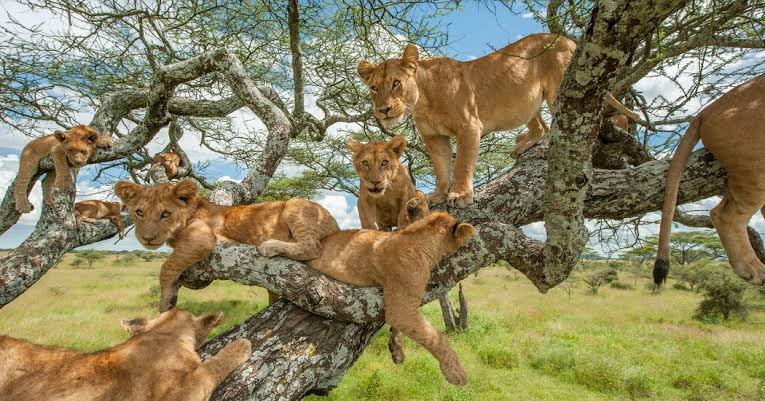
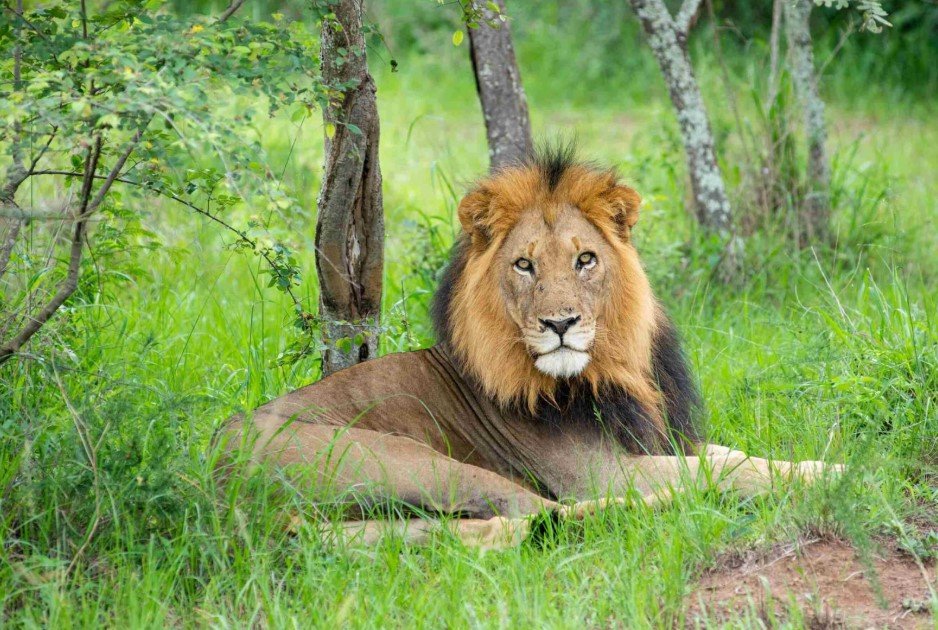
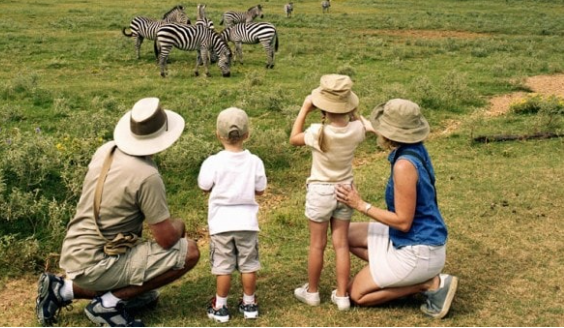
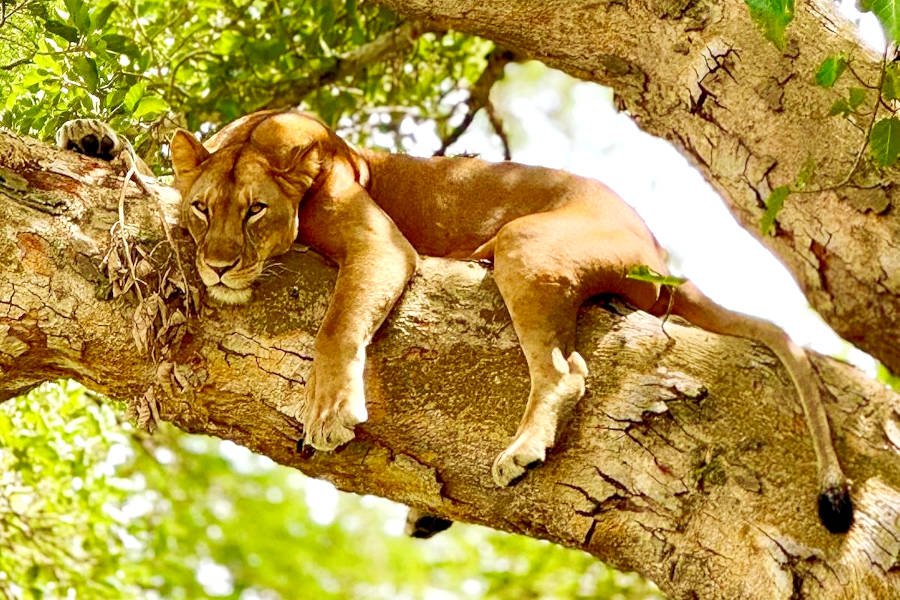
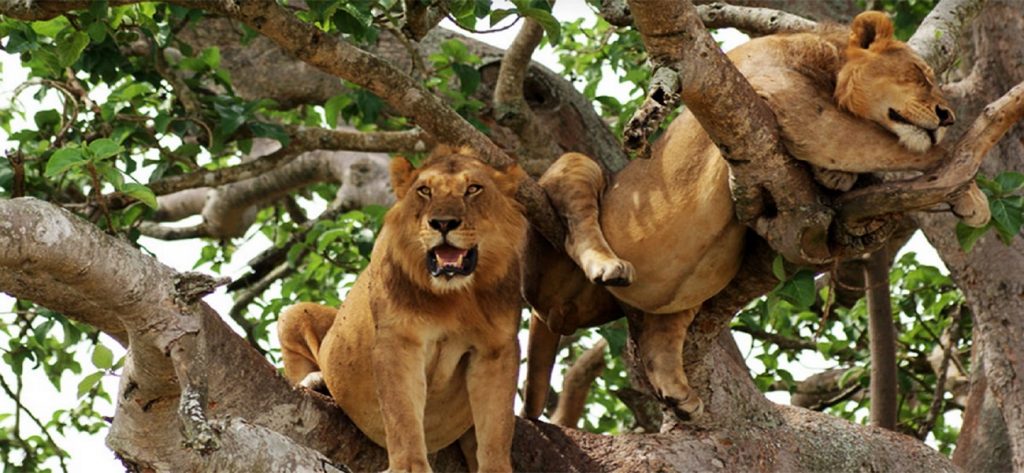
Tree climbing is not exclusive to lions in Uganda, but the regularity with which the behavior is associated with the Ishasha population has made these lions one of the country’s signature safari attractions. A lioness may be seen sleeping across a broad horizontal branch while another animal rests higher in the canopy, occasionally looking across the grasslands below. Sometimes several members of a pride may use the same tree, producing one of the most memorable photographic scenes available on a Uganda wildlife safari.
For travelers exploring Uganda with Nextgen Safaris, Ishasha is particularly convenient because it lies between the main northern areas of Queen Elizabeth National Park and the routes leading south toward Bwindi Impenetrable National Park. This allows travelers to search for tree-climbing lions before continuing toward the rainforest for gorilla trekking, creating two completely different wildlife experiences within the same journey. Uganda Wildlife Authority specifically identifies the Ishasha route as a way of connecting Queen Elizabeth with Bwindi while providing an opportunity to search for the iconic lions.
What Are Tree-Climbing Lions?
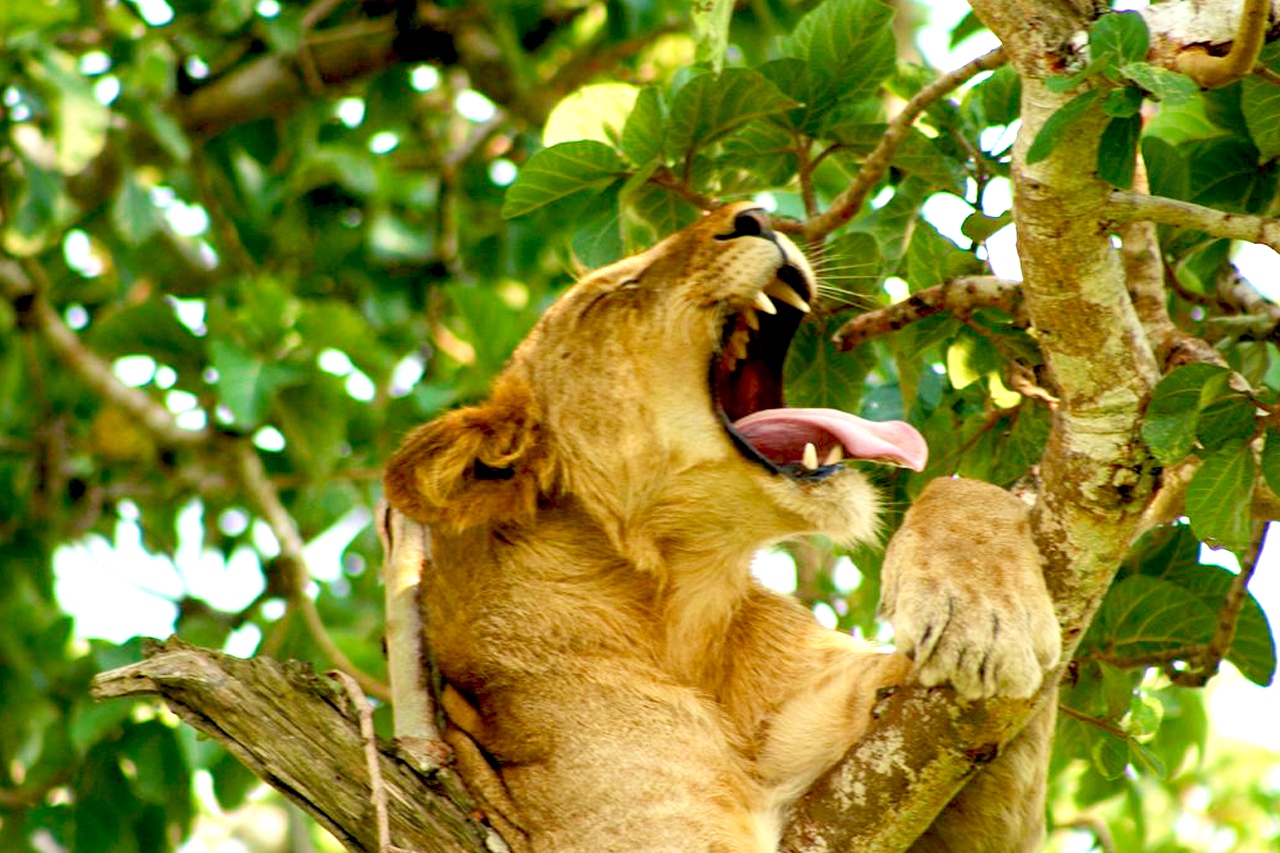
Tree-climbing lions are ordinary African lions that have developed a noticeable habit of climbing and resting in trees. Lions are physically capable of climbing, but they are much heavier and less naturally adapted to arboreal life than animals such as leopards. This makes the sight of a full-grown lion stretched across a branch especially striking. In Ishasha, visitors may find lions resting comfortably in large trees during the day while their bodies and tails hang across broad branches.
The behavior has become closely associated with southern Queen Elizabeth National Park. Uganda Wildlife Authority describes Ishasha as a particularly good place to search for lions because local prides regularly spend portions of the day resting in shady fig trees. These trees provide strong horizontal branches capable of supporting the weight of adult lions and sometimes several pride members at once.
A Tree-Climbing Lions Guide should therefore make an important distinction: seeing a lion in Queen Elizabeth National Park does not automatically mean seeing one in a tree. The animals remain wild and move according to prey, weather, social behavior and other natural influences. Some days may produce spectacular sightings of several lions resting above the ground, while on other days the lions may remain hidden in grass or travel through another part of their territory.
Where Can You See Tree-Climbing Lions in Uganda?
The best-known place to search for tree-climbing lions in Uganda is the Ishasha Sector of Queen Elizabeth National Park. Ishasha lies in the southern part of the park and has a noticeably quieter and more remote atmosphere than the busier areas around Kasenyi and the Kazinga Channel. Uganda Wildlife Authority consistently identifies the tree-climbing lions of Ishasha as one of the distinctive wildlife attractions of Queen Elizabeth National Park and Uganda generally.
The landscape consists of open savannah, woodland, riverine areas and scattered large trees. This environment creates excellent game-viewing conditions because guides can scan both the grassland and trees while driving through the sector. Large fig trees are particularly important when searching for resting lions, and experienced safari guides know which areas have historically produced sightings.
Ishasha’s location also makes it highly practical within a longer Uganda itinerary. Travelers can spend a night in the sector, explore it during both evening and morning game drives, and then continue toward Bwindi. Alternatively, guests traveling from the northern areas of Queen Elizabeth toward Bwindi can include a game drive through Ishasha during their transfer.
Why Do Lions Climb Trees?
One of the most interesting questions covered by a Tree-Climbing Lions Guide is why these lions climb trees. There is no single universally proven explanation, and travelers should be cautious about safari descriptions that present one theory as absolute scientific fact. Several explanations have instead been proposed based on observations of lion behavior.
One possibility is that climbing provides relief from heat at ground level. Large trees provide shade, while elevated branches can expose resting lions to moving air above the grass. Avoiding biting insects is another frequently proposed explanation, particularly where insects are concentrated closer to the ground. A third theory is that trees provide an elevated vantage point from which lions can observe the surrounding plains and potential prey. These explanations remain commonly discussed theories rather than one conclusively established cause.
The behavior may also have a learned component. Young lions living in prides where adults regularly climb may become accustomed to following other pride members into trees. Whatever the precise combination of reasons, the repeated tree use observed around Ishasha has created a behavioral tradition that has become internationally associated with the area.
The Ishasha Sector of Queen Elizabeth National Park
Ishasha deserves attention beyond its famous lions. Tree-Climbing Lions GuideThe sector has a peaceful wilderness atmosphere and broad savannah landscapes that can feel very different from the northern sections of Queen Elizabeth National Park. Because many visitors simply drive through Ishasha on their way to Bwindi, travelers who dedicate a proper morning or afternoon game drive can enjoy a more relaxed experience.
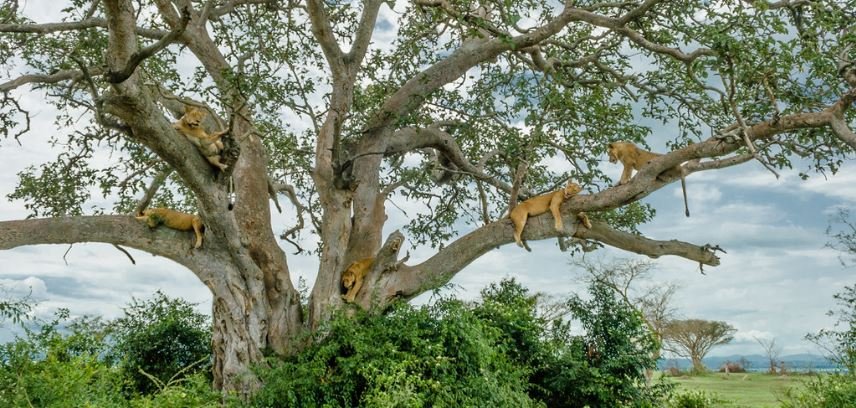
The sector forms part of the larger Queen Elizabeth ecosystem, one of Uganda’s most important protected landscapes. The wider park supports elephants, buffaloes, Uganda kobs, waterbucks, hippos, leopards, hyenas and many other mammals as well as exceptionally rich birdlife. Ishasha itself provides opportunities to see several of these species while searching for lions.
The Ntungwe River and surrounding habitats add ecological variety to the sector. UWA records hippos around the Ntungwe River in the Ishasha area, illustrating how the southern section includes both savannah and river-associated wildlife. For travelers who allow sufficient time, Ishasha therefore becomes a complete game-viewing destination rather than simply a place to check one animal off a list.
Tree-Climbing Lion Game Drives in Ishasha
Game drives are the principal way to search for the Ishasha lions. Visitors explore the sector in a safari vehicle while their driver-guide scans large trees, grasslands and other likely resting areas. Finding the lions sometimes requires patience because a lion lying along a branch can blend surprisingly well into the surrounding bark, shadows and foliage.
Early morning drives are particularly rewarding because temperatures are cooler and lions may still be active after nighttime hunting. Rather than immediately occupying the trees, animals might be seen walking through grassland, interacting with pride members or resting on the ground. Tree-Climbing Lions Guide, This provides opportunities to observe the lions behaving in several different ways.
Afternoon drives can also be excellent for tree sightings. During warm periods, lions may seek shaded resting places and remain inactive for considerable periods. Experienced guides carefully scan the crowns and broad horizontal branches of large trees rather than looking only across the ground.
For photographers and travelers whose main objective is seeing the tree-climbing behavior, spending more than one game drive in Ishasha is preferable. Wildlife is unpredictable, and additional time significantly improves the opportunity to encounter the lions under favorable viewing conditions.
Best Time to See Tree-Climbing Lions in Ishasha
The tree-climbing lions can be searched for throughout the year. Queen Elizabeth National Park remains a year-round safari destination, and the lions continue using their territories in every season. The appearance of the landscape and ease of game driving, however, can vary between wetter and drier periods.
During generally drier conditions, vegetation may be shorter, potentially making wildlife easier to detect across open plains. Roads can also be more straightforward to navigate. Warm daytime temperatures may encourage lions to seek shaded resting places, although there is never a guarantee that they will climb on a particular day.
The wetter months transform Ishasha into a greener environment that can be exceptionally attractive for photography. Taller grass and thicker vegetation may sometimes make wildlife harder to locate, but dramatic skies, green plains and healthy vegetation provide beautiful backgrounds when lions are found.
Rather than selecting a Uganda safari month only according to the lions, travelers should consider their complete itinerary. Tree-Climbing Lions Guide, Those combining Ishasha with gorilla trekking, chimpanzee trekking, Kazinga Channel cruising and additional game viewing should select travel dates that work well across the entire journey.
Are Tree-Climbing Lion Sightings Guaranteed?
No responsible Tree-Climbing Lions Guide should guarantee that visitors will find lions in trees. These are completely wild animals and their behavior changes from day to day. A pride may spend hours resting in a familiar tree one afternoon and be several kilometers away the following morning.
Even seeing lions themselves cannot be absolutely guaranteed. Uganda Wildlife Authority describes Ishasha as an area where the chances of finding lions are particularly good and specifically highlights their habit of resting in fig trees, but wildlife observation always depends on natural movement.
Good guiding can significantly improve the experience. Experienced safari guides understand previous sightings, preferred habitats and likely resting locations. They also communicate with other guides where appropriate, allowing them to concentrate on productive sections without disturbing the animals.
The best approach is to regard a lion actually resting in a tree as an extraordinary wildlife encounter rather than something that happens automatically simply because a traveler enters Ishasha.
Other Wildlife in Ishasha
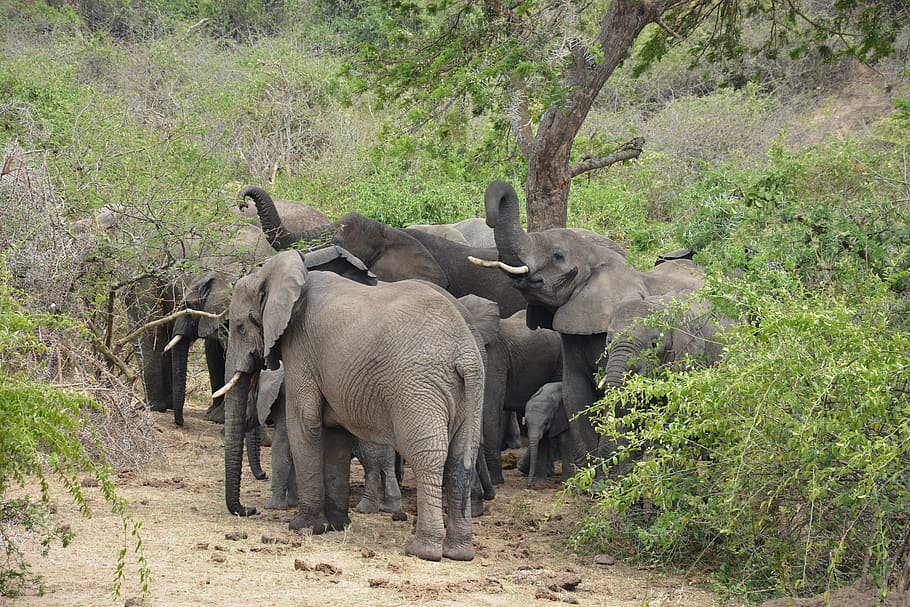
Although tree-climbing lions receive most of the attention, a safari through Ishasha can reveal a variety of other wildlife. Tree-Climbing Lions Guide, Large herds of Uganda kob provide important prey for predators, while buffaloes, elephants, waterbucks and other animals may be encountered during game drives.
Leopards also occur within Queen Elizabeth National Park, although they are considerably more secretive than lions. Uganda Wildlife Authority lists Queen Elizabeth among Uganda’s protected areas where visitors have a chance of seeing leopards. A leopard sighting in Ishasha would therefore be an exceptional addition to a lion-focused game drive.
Birdlife is another major attraction. Raptors, savannah birds and woodland species add interest throughout the drive, especially for travelers who take time to observe more than mammals. This diversity means visitors should avoid becoming so focused on looking into trees for lions that they overlook everything happening across the surrounding landscape.
Tree-Climbing Lions Photography
Photographing a lion high in a tree requires a different approach from conventional ground-level lion photography. Tree-Climbing Lions Guide, The viewing angle may be steep, foliage can partially obscure the animal and bright skies behind the branches can make exposure challenging. Patience and careful positioning therefore make a significant difference.
A telephoto lens is extremely useful because it allows photographers to capture expressions, paws, eyes and other details without encouraging the safari vehicle to approach too closely. Wider lenses can also produce beautiful environmental images showing the lion surrounded by the tree and open Ishasha landscape.
Morning and late-afternoon light can be particularly attractive. Warm sunlight across the lion’s coat creates richer colors, while lower light angles reduce some of the harsh shadows associated with midday photography. When several lions occupy the same tree, a wider composition can sometimes tell a much stronger story than an extremely close portrait.
Photographers should always prioritize responsible viewing over obtaining a particular image. Vehicles should not crowd wildlife, block movement or pressure animals to change position simply to create a better photograph.
Tree-Climbing Lions and Conservation
The Ishasha lions are not only a tourism attraction; they form part of Uganda’s broader large-carnivore conservation challenge. Tree-Climbing Lions Guide, Habitat pressure, declining prey in some landscapes, wildlife crime and conflict between people and large carnivores remain issues requiring continued management. Uganda Wildlife Authority’s current conservation planning recognizes the iconic Ishasha tree-climbing lions within its wider strategy for large carnivore conservation.
Uganda’s 2026 State of Wildlife Resources reporting also highlights broader pressures affecting wildlife nationally, including habitat fragmentation, expanding human settlement and the need for stronger human-wildlife conflict mitigation. These challenges matter particularly for wide-ranging carnivores such as lions, which require sufficient prey, habitat and safe movement areas.
Tourism has an important role because wildlife creates economic value when living animals and healthy ecosystems support tourism businesses, employment and community programs. UWA also operates revenue-sharing mechanisms and community conservation initiatives around Uganda’s protected areas. Responsible visits to Ishasha therefore contribute to a broader tourism economy that depends on protecting these animals over the long term.
How to Behave Around Tree-Climbing Lions
Visitors should always remember that the lions are wild predators rather than animals conditioned for close human interaction. Tree-Climbing Lions Guide, Travelers must remain inside their safari vehicle during ordinary game drives unless a guide specifically indicates an authorized place where leaving the vehicle is permitted.
Noise should be kept low, particularly when lions are resting. Shouting to make an animal lift its head, encouraging a driver to move dangerously close or pressuring a lion to change position for photography undermines responsible wildlife tourism.
Guests should also avoid directing drivers to leave authorized tracks simply to obtain a closer photograph where this is prohibited.Tree-Climbing Lions Guide, A good safari experience balances wildlife viewing with respect for the habitat and other visitors.
Allowing animals to behave naturally often results in more interesting observations anyway. A resting lion may eventually wake, change branches, interact with another pride member or descend from the tree if given enough time and space.
Combining Tree-Climbing Lions with the Kazinga Channel
Travelers staying in Queen Elizabeth National Park can easily combine an Ishasha lion safari with the famous Kazinga Channel boat cruise in the northern section of the park. This creates two completely different wildlife experiences within one national park.
A game drive focuses on terrestrial wildlife across open savannah, while the Kazinga Channel provides opportunities to observe hippos, crocodiles, elephants, buffaloes and abundant water birds from a boat. This variety is one of the major reasons Queen Elizabeth is such a rewarding destination for first-time Uganda safari travelers.
A well-designed itinerary can dedicate time to the northern wildlife areas and Kazinga Channel before moving south through Ishasha. Tree-Climbing Lions Guide, This avoids rushing and increases the possibility of enjoying both the park’s famous aquatic ecosystem and its tree-climbing lions.
Combining Tree-Climbing Lions with Gorilla Trekking
One of the strongest Uganda safari combinations connects the tree-climbing lions of Ishasha with gorilla trekking in Bwindi Impenetrable National Park. Uganda Wildlife Authority specifically notes the Ishasha route when describing travel toward Bwindi and identifies the opportunity to stop in search of the famous lions.
The contrast between the two experiences is extraordinary. In Ishasha, travelers remain inside a 4×4 vehicle and search open savannah and fig trees for lions.Tree-Climbing Lions GuideTree-Climbing Lions Guide, In Bwindi, they enter a dense tropical rainforest on foot with guides and trackers to search for a habituated mountain gorilla family.
A traveler can therefore experience one of Uganda’s most distinctive predator behaviors and one of the world’s greatest primate encounters within the same safari. This combination is particularly effective for travelers with around a week or longer in Uganda, especially when Queen Elizabeth’s Kazinga Channel and other wildlife experiences are incorporated along the route.
Where to Stay for an Ishasha Tree-Climbing Lion Safari
Travelers who strongly prioritize tree-climbing lions should consider spending at least one night in or around Ishasha rather than simply passing through during the middle of the day. Staying nearby allows an evening game drive followed by another opportunity the next morning, significantly improving flexibility.
Accommodation options around the sector range from comfortable safari camps to higher-end lodges depending on budget and availability. Tree-Climbing Lions Guide, The most important consideration is location. Staying close enough to productive Ishasha game-drive areas reduces unnecessary transfer time and allows visitors to begin exploring while wildlife is active.
Travelers using Ishasha primarily as the connection between Queen Elizabeth and Bwindi may choose one night, while photographers or serious wildlife enthusiasts may benefit from two. Nextgen Safaris can select accommodation according to the route, budget and intended number of game drives.
How Many Days Are Best for Seeing Tree-Climbing Lions?
A single dedicated game drive may produce a successful sighting, but travelers whose main priority is the lions should ideally build enough flexibility into their itinerary for more than one opportunity.Tree-Climbing Lions Guide, Wildlife does not work according to a fixed timetable, and rushing through Ishasha for only an hour during a transfer can easily result in disappointment.
One night in Ishasha works well for many Uganda safaris because it allows an afternoon game drive and another search the following morning. Two nights provide even greater flexibility and are particularly suitable for photographers or travelers who enjoy slower wildlife experiences.
Travelers continuing toward Bwindi do not need to add several unnecessary days simply to include the lions. Tree-Climbing Lions Guide, The geographical relationship between the two destinations makes it possible to design an efficient itinerary where Ishasha becomes a meaningful safari stop rather than a major detour.
Is Seeing the Tree-Climbing Lions Worth It?
For wildlife enthusiasts, the Ishasha tree-climbing lions are absolutely worth including in a Uganda safari. The attraction is not simply seeing another lion. It is seeing an animal normally associated with open grasslands behaving in a way that feels completely unexpected.
Watching a lion stretched across the branch of a massive fig tree while antelopes graze across the plains below creates a scene that immediately distinguishes Ishasha from conventional game-viewing areas. Tree-Climbing Lions Guide, The quieter atmosphere of the southern sector adds to the experience, particularly when visitors allow enough time rather than racing toward their next destination.
The lions also fit naturally into Uganda’s strongest wildlife circuit. Travelers can experience chimpanzees in Kibale, wildlife and the Kazinga Channel in Queen Elizabeth, tree-climbing lions in Ishasha and mountain gorillas in Bwindi within one carefully planned journey.
For this reason, a Tree-Climbing Lions safari is best viewed not as an isolated excursion but as one distinctive chapter within a broader Uganda wildlife adventure.
Frequently Asked Questions About Tree-Climbing Lions Guide
1. What is a Tree-Climbing Lions Guide?
A Tree-Climbing Lions Guide helps travelers understand where to see tree-climbing lions in Uganda, how the safari experience works, the best time to visit, what wildlife to expect and how to plan a visit to the Ishasha Sector of Queen Elizabeth National Park.Tree-Climbing Lions Guide, It is especially useful for travelers combining wildlife viewing with gorilla trekking in Bwindi.
2. Where can I see tree-climbing lions in Uganda?
The best-known place to see tree-climbing lions in Uganda is the Ishasha Sector of Queen Elizabeth National Park. Lions in this area are famous for resting in large fig trees during the day. This Tree-Climbing Lions Guide recommends allowing enough time for a dedicated Ishasha game drive rather than relying only on a quick transfer through the sector.
3. Why do lions climb trees in Ishasha?
There is no single confirmed reason why Ishasha lions climb trees. Tree-Climbing Lions Guide, Possible explanations include escaping heat at ground level, avoiding insects and gaining a better view of the surrounding plains. Tree-Climbing Lions Guide, The behavior may also be learned within local prides. Whatever the reason, seeing lions resting in trees is one of Uganda’s most unusual wildlife experiences.
4. Are tree-climbing lion sightings guaranteed?
No. Tree-climbing lions are wild animals, so sightings cannot be guaranteed. The lions may be resting in trees, walking through the grasslands or moving elsewhere within their territory. A good guide and sufficient time in Ishasha improve the chances of a successful sighting, which is why this Tree-Climbing Lions Guide recommends more than a very short visit.
5. What is the best time to see tree-climbing lions?
Tree-climbing lions can be searched for throughout the year. Early mornings and late afternoons are generally productive times for wildlife viewing because temperatures are cooler and animals may be more active. Tree-Climbing Lions Guide, During warmer periods, lions may also spend more time resting in shaded trees, although their behavior remains unpredictable.
6. How many days do I need for a tree-climbing lions safari?
One night in or near Ishasha is suitable for most travelers because it allows an afternoon game drive and another opportunity the following morning. Travelers whose main interest is wildlife photography may prefer two nights. Tree-Climbing Lions Guide, A longer stay provides more flexibility because lion movements change naturally from one day to another.
7. What other wildlife can I see in Ishasha?
Besides tree-climbing lions, visitors can see elephants, buffaloes, Uganda kobs, waterbucks and several other wildlife species in the Ishasha Sector. Leopards and other predators are also present but are more difficult to encounter. Birdlife is excellent, making Ishasha rewarding even when the lions are not immediately located.
8. Can I combine tree-climbing lions with gorilla trekking?
Yes. Combining the tree-climbing lions of Ishasha with gorilla trekking in Bwindi Impenetrable National Park is one of the best Uganda safari combinations. Tree-Climbing Lions Guide, Travelers can search for lions in Queen Elizabeth National Park before continuing south toward Bwindi for a mountain gorilla trek. The two experiences provide an excellent contrast between open savannah and tropical rainforest.
9. Is a tree-climbing lions safari worth it?
Yes. A tree-climbing lions safari is worth including for travelers interested in unusual animal behavior and wildlife photography.Tree-Climbing Lions Guide, Seeing a large African lion stretched across the branches of a fig tree is very different from a conventional lion sighting on the ground. Ishasha also offers beautiful scenery and a quieter safari atmosphere than some busier wildlife areas.
10. How can I book a tree-climbing lions safari?
You can book a tree-climbing lions safari with Nextgen Safaris as part of a Queen Elizabeth National Park itinerary or a longer Uganda journey. Tree-Climbing Lions Guide, The safari can include private 4×4 transportation, professional driver-guiding, Ishasha game drives, accommodation, a Kazinga Channel boat safari and onward travel to Bwindi for gorilla trekking.
Book Your Tree-Climbing Lions Safari with Nextgen Safaris
A Tree-Climbing Lions Guide can help you understand the experience, but successful wildlife viewing ultimately depends on good itinerary planning, enough time in Ishasha and an experienced safari guide who understands the landscape. Tree-Climbing Lions Guide, Nextgen Safaris can arrange private Ishasha game drives as part of a Queen Elizabeth National Park safari or incorporate the tree-climbing lions into a longer Uganda itinerary. Your journey can include private 4×4 safari transportation, professional driver-guiding, carefully selected accommodation, Queen Elizabeth game drives, a Kazinga Channel boat safari and onward travel toward Bwindi.
For travelers wanting the most complete experience, we can combine the tree-climbing lions of Ishasha with gorilla trekking in Bwindi, chimpanzee trekking in Kibale and other Uganda wildlife destinations. Budget, mid-range and luxury itineraries can be customized according to your dates, available time and preferred travel pace. Contact Nextgen Safaris to book your Tree-Climbing Lions safari and experience the remarkable lions of Ishasha as part of an unforgettable Uganda wildlife journey.